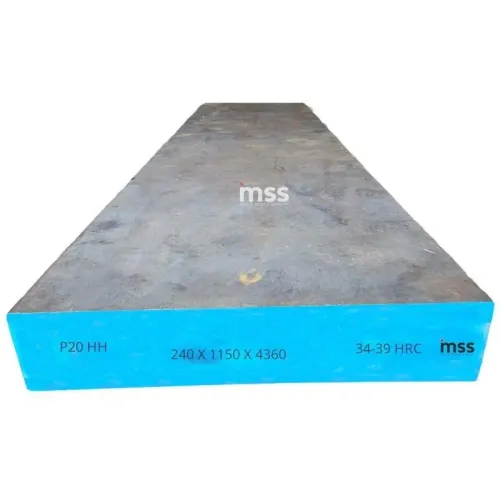
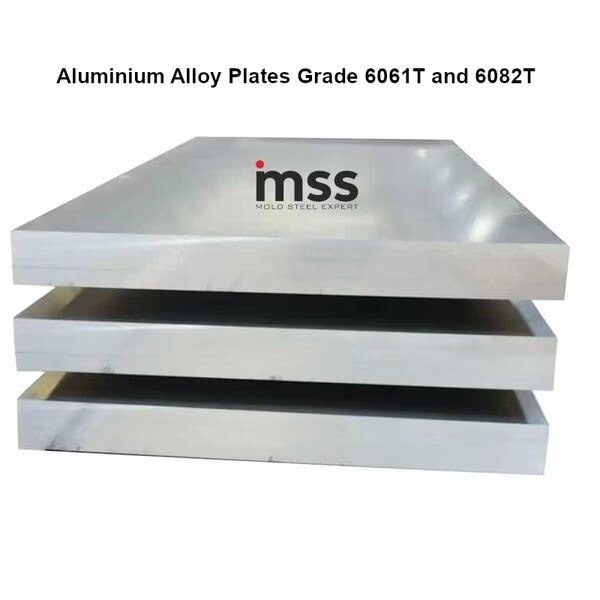
Choosing 6082 aluminium for a mould depends on where low weight, fast machining, and heat transfer create value—and where steel’s wear resistance and dimensional stability are more important. You will be able to match the alloy and temper to the mould component, evaluate an 80 mm plate, plan machining and thermal clearances, and check a Gurugram supplier before ordering.
Key takeaways
- Use 6082 aluminium for lightweight, fast-machined, low-wear mould structures.
- Specify the temper, thickness tolerance, flatness, and inspection documents before ordering.
- Check cooling channels, threaded holes, and galvanic contact with steel components.
- Choose P20 when cavity wear, pressure, and production volume outweigh weight savings.
Where 6082 aluminium earns a place in a plastic mould
6082 aluminum plate for mould making earns its place when low weight, fast CNC machining, and rapid design changes matter more than maximum wear resistance. It suits prototype moulds, bridge plates, back plates, support plates, clamping plates, cavity-holder structures, fixtures, and low-to-medium-volume tooling.
A lighter tool is easier to lift, align, modify, and replace during validation.
| Component or production situation | 6082 aluminium | Mould steel |
|---|---|---|
| Mould bases, back plates, and support plates | Suitable when loads and production volume are moderate | Prefer steel for high clamp pressure, heavy side loads, or long service |
| Prototype and bridge tooling | Strong choice for quick machining and frequent design changes | Steel adds cost and machining time before the design is proven |
| Cavity-holder structures and fixtures | Suitable when the cavity surface does not carry the wear | Use steel for the cavity, core, shut-off, or guide surface when wear matters |
| Low-volume moulds and short campaigns | Suitable when easy replacement and low handling weight reduce downtime | Steel is safer when repeatability across many shots matters |
| Glass-filled or abrasive resin tooling | Use only for protected structural parts | Choose P20, 1.2311, 1.2738, H13, or S136 for exposed working surfaces |
The key 6082T aluminum plate applications in Gurugram are fast-turnaround, low-to-medium-volume jobs where tooling life is limited by the project rather than by wear.
Choose steel when the mould faces abrasive resin, repeated high-temperature cycles, demanding polish, high compressive stress, or a costly production interruption; 6082 aluminium is not a direct substitute for hardened mould steel.
How to specify the temper and evaluate an 80 mm plate
An 80 mm plate is suitable for a large mould base, back plate, or structural block when the design controls deflection and the mould does not need hardened steel’s wear resistance. It is not automatically a finished 80 mm component: stock thickness, machining allowance, and residual stress affect the final size.
For 6082T aluminum alloy plate 80mm in Gurugram, put these details on the order:
1. Specify EN AW-6082 and the complete temper, such as T6 or T651. T651 identifies solution heat treatment, artificial ageing, and stress relieving by controlled stretching; “6082T” alone is incomplete.
2. State the applicable product standard, plate length and width, nominal 80 mm thickness, thickness tolerance, flatness, squareness, surface condition, and sawing allowance. Ask whether the quoted 80 mm is stock size or guaranteed final thickness.
3. Require a material certificate showing chemical composition, mechanical properties for the ordered thickness and temper, heat or batch number, dimensions, and standard. Do not use thin-sheet strength data to assess an 80 mm plate.
4. Confirm cut size, machining allowance, quantity, lifting and delivery condition. A thick plate needs rigid fixturing and staged machining; removing material from one face can release stress and warp the block.
T651 is usually the safer choice for a machined mould base where dimensional movement matters. Choose steel instead for high clamp-pressure tooling, glass-filled resin, long runs, or cavity surfaces needing high wear and polish retention.
Machining, cooling, and mixed-metal design checks
At 80 mm, rough-machine 6082 from both faces in balanced passes. Removing most stock from one side releases residual stress and bows the plate. Clamp across broad, supported areas with moderate force, and leave a controlled finishing allowance instead of pulling a distorted blank flat against the fixture.
- Face the first side and remove only part of the planned stock.
- Turn the plate, support it on the machined face, and balance stock removal on the second side.
- Let the block stabilise after roughing, then check flatness on an inspection table.
- Finish-machine datums, cavity-holder surfaces, parting faces, and dowel bores in a separate setup.
- Use sharp carbide cutters, rigid workholding, effective chip evacuation, and coolant that prevents local heat build-up.
- Measure critical dimensions after the plate and machine reach the same stable shop temperature.
The practical value of aluminum plate for plastic mould manufacturers depends on controlling movement after machining. Aluminium expands at about 23 micrometres per metre per °C, compared with roughly 11–13 for mould steel. A 300 mm aluminium-to-steel span facing a 40°C change can create about 0.12–0.14 mm of differential movement.
Use one fixed locating datum, then slots or clearance holes that let the aluminium move away from that datum; do not hard-pin both ends. Isolate wet aluminium-steel joints against galvanic corrosion, and check dowel-bush fits after thermal cycling.
Design cooling channels around wall thickness and steel inserts, because fast heat transfer does not guarantee uniform cooling or a shorter cycle.
Choosing 6082, P20, or another mould steel by production risk
Mould size and production risk set the boundary: 6082 suits a large, light base or prototype tool that you can replace easily, while hardened steel earns its weight when failure would interrupt a long run. Glass-filled resin, high shot count, tight shut-offs, and difficult polishing all move the decision toward steel.
| Option | Production profile | Choose it when |
|---|---|---|
| 6082 | Fast machining, low weight, low wear resistance | The mould is large, short-run, frequently redesigned, or used for prototypes and low-wear support components. Use steel inserts at shut-offs, slides, and ejector contact points. |
| P20 | Prehardened general-purpose mould steel | You need a dependable cavity for moderate shot counts, ordinary resins, good dimensional stability, and a practical moulding surface without extensive hardening. |
| 1.2311 | P20-type prehardened steel with consistent machining behaviour | The tool needs more robust cavity and core service than aluminium, especially at medium size and medium production volume. |
| 1.2738 | Tougher nickel-alloyed prehardened mould steel | Choose it for large blocks, deeper cavities, higher toughness demands, or sections where cracking and distortion would be expensive. |
| H13 | Hot-work steel retaining strength at elevated temperature | The resin or process keeps the mould hot, thermal cycling is severe, or high clamp pressure and repeated wear threaten prehardened steel. |
| S136 | Stainless mould steel suited to polishing and corrosion resistance | Choose it for mirror-polished surfaces, clear parts, corrosive resins, humid service, or coolant exposure. |
Replaceability matters: use aluminium when machining a replacement is faster than protecting maximum tool life. Select steel when a cavity surface, texture, or production interruption is costly to recreate.
What to verify before ordering from a Gurugram plate supplier
A stock label reading “6082T” does not prove the plate’s temper or compliance. Write EN AW-6082 and the exact temper, such as T6 or T651, on the purchase order; for a large mould block, T651’s stress-relief stretching is preferable to an unspecified T6 when the certificate confirms it.
Ask the 6082t plate supplier in gurugram for these details before payment:
- A material certificate naming EN AW-6082, temper, governing standard, chemical composition, mechanical properties for the ordered thickness, heat or batch number, and supplied dimensions.
- For an 80 mm plate, the permitted thickness range, flatness, squareness, surface condition, and whether 80 mm means nominal or finished thickness.
- The cut size, sawing allowance, cutting method, edge condition, and machining allowance on every face. Do not accept a cut blank that leaves too little material to remove distortion.
- Dry, supported transport with edge protection, wrapping against rain and chloride contamination, and inspection for dents, scratches, staining, and bent corners on arrival.
- A written replacement rule covering incorrect alloy or temper, certificate mismatch, out-of-tolerance dimensions, concealed laminations, and transport damage. Keep photographs and the heat number before machining.
| Check | Evidence to retain | Failure it prevents |
|---|---|---|
| Certificate | Certificate matching heat number and order | Untraceable or wrong-temper stock |
| Dimensions | Measured thickness, flatness, squareness | A distorted mould base |
| Delivery | Signed inspection record and photographs | Disputed damage claims |
Milano Special Steel, Plastic Mold Steel Expert can be compared on this documentation, not only on quoted price.
Related product
 | 6082T Aluminum Alloy Plate 6082T Aluminum Alloy Plate 80mm Aluminium Alloys Plates 6082T: Premium Quality for Plastic Mould, Aerospace & Auto Parts | Best Price in India from Top Suppliers Introduction to... View product → |
Frequently asked questions
Where does 6082 aluminium earn a place in a plastic mould?
Use it for prototype moulds, bridge plates, back plates, support plates, clamping plates, cavity-holder structures, fixtures, and low-to-medium-volume tooling where low weight and fast machining matter.
What should you check when buying an 80 mm 6082T aluminium plate?
Confirm the exact temper, 80 mm nominal thickness, thickness tolerance, flatness, surface condition, cut size, heat or batch number, and inspection documents.
What machining and cooling checks apply to 6082 aluminium mould plates?
Plan for aluminium-specific cutting tools and chip evacuation, account for thermal expansion, maintain adequate material around cooling channels, and inspect threaded holes and sealing faces after machining.
Should you choose 6082 aluminium or P20 mould steel?
Choose 6082 when low mass, quick machining, and design changes dominate. Choose P20 when cavity wear, repeated production loads, higher clamping stress, and longer service life dominate.
Keywords